
Big countries don’t always pay big wages. Minimum pay tells us how a worker starts-not where they finish. Some nations set one national rate. Others let regions decide. So numbers vary.
In this post, I compare the minimum monthly income in the 10 most powerful countries (2025). I convert official rates to a monthly USD view so it’s easy to scan. Keep in mind: taxes and living costs change how far a wage goes. But this table gives a clear starting point.
What Is Minimum Wage?
Minimum wage is the lowest salary that employers are legally allowed to pay their workers. It’s set by each country’s government and usually depends on:
- Cost of living
- Economic strength
- Labor laws
- Social welfare policies
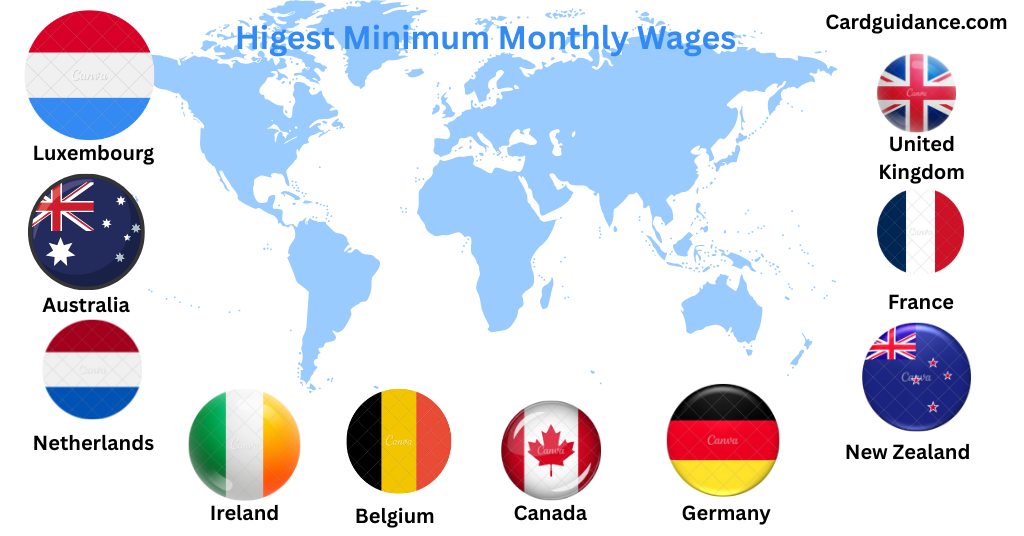
Top 10 Powerful Countries & Their Minimum Monthly Income (2025)
| Rank | Country | Approx. Minimum Monthly Wage (USD) |
|---|---|---|
| 1 | Luxembourg | $3,214 ( INR 2,82,832) |
| 2 | Australia | $2,562 ( INR 2,25,456) |
| 3 | Netherlands | $2,500 ( INR 2,20,000 ) |
| 4 | Ireland | $2,402 ( INR 2,11,376) |
| 5 | Belgium | $2,127–2,181 ( INR 1,87,176-1,91,928) |
| 6 | Canada | $1,800–2,300 ( INR 1,58,400-2,02,400) |
| 7 | Germany | $2,172 ( INR 1,91,136) |
| 8 | New Zealand | $2,368 ( INR 2,08,384) |
| 9 | France | $1,977 ( INR 1,73,976) |
| 10 | United Kingdom | $2,499–2,501 ( INR 2,19,912-2,20,088) |
Key Insights
- Luxembourg has the highest monthly minimum wage in the EU: €2,704 per month (1 July 2025).
- Australia sets a national minimum of AUD $24.95/hour or $948/week (from 1 July 2025).
- United Kingdom: £12.21/hour for ages 21+ from 1 April 2025 (National Living Wage).
- Germany: €12.82/hour from 1 January 2025.
- United States (federal floor): $7.25/hour; many states set higher rates.
Why This Matters for You
Whether you’re a student, a traveler, or a financial planner, understanding global income levels helps you:
- Know pay levels in top countries.
- Plan study, travel, or work abroad.
- Set fair wage goals in your area.
- Compare pay with local living costs.
Final Thoughts
Minimum wage is not just a number. It shows how a country treats its lowest-paid workers. Big economies do not always pay high minimums.
Look at taxes and prices too, not only the wage.